Thursday, October 12, 2006

The Atmosphere

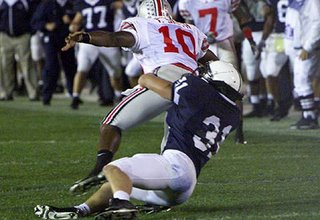
At the weekly PSU press conference Joe Paterno was asked: What do you remember about last year’s night game with Ohio State and how did that atmosphere of the crowd contribute to the specialness of that night?

Joe Pa responded: "I think the whole environment last year, and I would hope we would have the same kind of environment this Saturday night against Michigan, is one of excitement, fun and the things that are really great to be part of. To be frank with you, I felt the same way when we went out to Ohio State this year. That was a great crowd. They were in it, all dressed in red and you felt like you were part of something exciting. People keep asking me, “Why do you still coach?” Those are the kind of days that you back away and say, “Boy, am I going to miss those when I am home cutting grass.” It is just a whole different environment. I think this Saturday night should be a very exciting, special night. The crowd won’t win the game for us. I will give you a clue. We have to win the game. It isn’t going to come down to the crowd. The Michigan kids are not going to be intimidated by any crowd. They are going to play because they are a good, solid football team. The crowd will help, they will have a lot of fun and it will be great to see all of the white. It makes you feel like it is one of those events in your life that very few people take part in, but it isn’t going to win the game."

Reading Coach Paterno's answer reminded me of another writer's excitement. Hebrews, chapter 12 begins, "Therefore, since we are surrounded by such a great cloud of witnesses, let us throw off everything that hinders and the sin that so easily entangles, and let us run with perseverance the race marked out for us . . . "

And the chapter ends with, "Therefore, since we are receiving a kingdom that cannot be shaken, let us be thankful, and so worship God acceptably with reverence and awe . . . "

This
life is a journey filled with excitement, challenge, trials, and ultimately victory, if our faith in Jesus Christ is unwavering. Coach Paterno, at age 79, is still passionately in love with the sport. He has faced some hard knocks, but his zeal is still evident. How about you? I love life, in spite of the curve balls and sliders. I love the ministry in spite of interceptions, fumbles, and penalties. It's those TD's, the great plays, the roar of the crowd, the cloud of witnesses that keep the enthusiasm alive within me. Life in Christ is just a totally different environment.

Let us fix our eyes on Jesus, the author and perfecter of our faith, who for the joy set before him endured the cross, scorning its shame, and sat down at the right hand of the throne of God. Consider him who endured such opposition from sinful men, so that you will not grow weary and lose heart. (Heb 12:2-3 NIV)

Wednesday, October 11, 2006

Your Priority

What is important to you in this life? More stuff? Possessions? Bigger barns? Power? Control? What is tempting? What is enticing? Think about these words of Jesus.

Matt 16:24-28
Then Jesus said to his disciples, "If anyone would come after me, he must deny himself and take up his cross and follow me. For whoever wants to save his life will lose it, but whoever loses his life for me will find it. What good will it be for a man if he gains the whole world, yet forfeits his soul? Or what can a man give in exchange for his soul? For the Son of Man is going to come in his Father's glory with his angels, and then he will reward each person according to what he has done. I tell you the truth, some who are standing here will not taste death before they see the Son of Man coming in his kingdom."

Influence and authority is very appealing. But to what expense should an individual pursue such? Jesus had the opportunity to have all the earthly power, authority, and influence given to him by the devil during his desert temptation. Satan offered Jesus all the kingdoms of the world (Luke 4:5-7), all their splendor and all authority to rule over them, if only Jesus would bow down and worship Satan. But Jesus refused such an opportunity.

Can you imagine that? As Alicia Chole wrote in her book Anonymous", what we could do with such power. We could . . .

". . . end child prostitution,
. . . make sure no one ever died of hunger again,
. . . find a home for every homeless soul,
. . . protect the helpless,
. . . provide jobs for the jobless,
. . . pursue justice for the oppressed,
. . . channel money toward truly worthy causes,
. . . ensure the elderly were never abandoned,
. . . prosecute drug traffickers,
. . . create the best environment possible for those with special needs,
. . . offer a college education to every desiring student,
. . .make sure everyone had adequate medical care,
. . . create and enforce laws to detox the environment,
. . . protect our natural respurces,
. . . remove abusive world leaders, and
. . . end most wars before they began."

I can think of a few others to add to that list. So can you.

Yet, Jesus recognized something far greater than obtaining an earthly kingdom. He recognized that nothing was more important than his relationship with God. He refused Satan's bribe. Jesus answered with, "Worship the Lord your God and serve him only."

The kingdom of Heaven is of greater value to this world than all the kingdoms of this world is to itself.

Tuesday, October 10, 2006

As A Man Thinks, So He Is

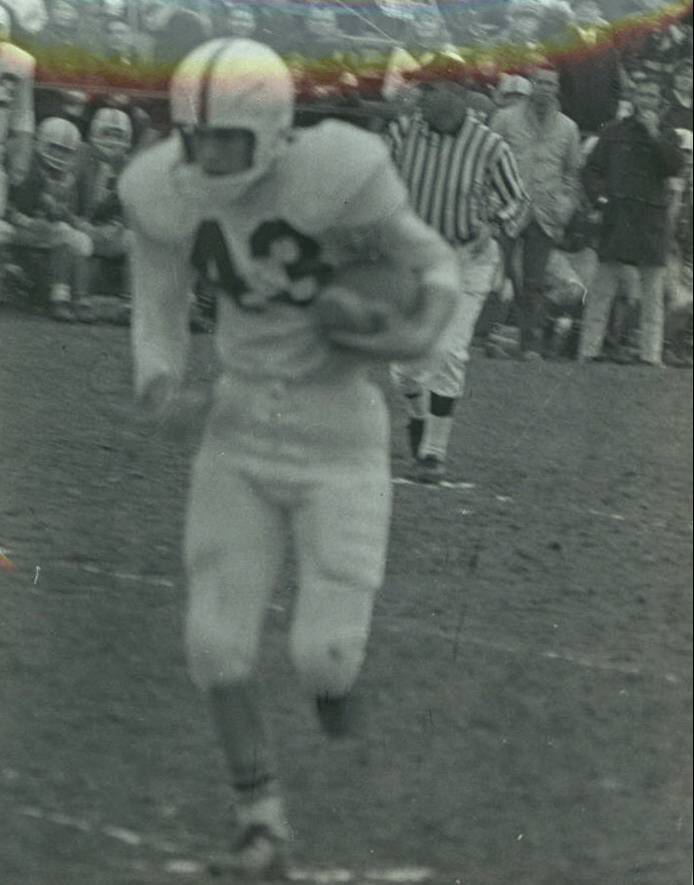
Yes, that's me running for a touchdown, my senior season in 1968, during our school's traditional Thanksgiving Day game.

In 1967, “Doc” Miller, my high school football coach, took over a winning tradition of which I had been a part of. In the nine years that I played the sport, only one year did my team mates and I have a losing season - our very first year together in the local midget football league. As a team, we played together on and off the field. We remained friends, as well as team mates, throughout grammar school and high school.


During “Doc’s” first year as our coach, we lost our first three games. Following our third loss, to our arch rival, he walked into a quiet and very discouraged locker room of players, and said ever so softly but forcefully, “I have shouldered the blame for the first two losses saying it was poor coaching and poor planning. But, I will not carry the blame for this game!” I will never forget those words or his thundering words that followed, NO MORE!!!


We went on to win the next six games that season, finishing with a 6-3-0 record. We won an additional 5 games the next season before our 11 game winning streak came to an end. Our senior and final year together, we finished the season with a 7-2-0 record.


The point of my story is this, "Doc" knew we were a better team. He knew that we also knew it. As a man thinks, so he is. Sometimes we concentrate on our mistakes, our failures, our blown opportunities. We replay in our minds the dropped pass, the missed block, the foolish penalty, the bad play call. We do the same thing in our spiritual walk. We replay in our mind the time we looked foolish; the word we wish we had not said; the slight that should never have been spoken; the missed opportunity; the botched plan. God says, the past is past. “Though your sins are like scarlet, they shall be white as snow.” (Isaiah 1:18)


All that matters is the future. God delights in taking people who are disappointed with themselves and helping them get hold of themselves and make a bold, new beginning.


“Doc” Miller was a good coach. It was my privilege a few years later to be at his bedside with several other former students and players to hear him pray the sinner's prayer. A few months later, he crossed the eternal goal line . . .

Monday, October 09, 2006

A Warming Fire

Over the weekend:

. . . Penn State won over Minnesota in overtime 28-27 :-)
. . . the Yankees lost and were eliminated from the series :-( (at least the Mets are still alive in the NL)
. . . New England Patriots won and are 4-1 :-)


. . . I went cruising on the lake one final time before the boat is taken out of the water and winterized for the winter. :-(


This last point got me thinking about our chilly fall mornings. How nice it is to warm one self by a fire on a crisp fall morning.


Towards the end of Jesus' earthly ministry we read of Peter warming himself by a fire. However, the companions he associated with around that fire provided him opportunity to deny his Lord and Savior. How sad, for three years he had been part of the inner circle of Jesus' associates. Yet, at the most critical moment he failed and denied the Lord (Luke 22:52-60).

After Jesus' ressurection but before his ascension, we read of Peter beside still another fire (John 21:1-7-9). At this fire we find Jesus. Jesus is restoring Peter's relationship with the Lord.

Two warming fires. Two different groups of people. Two different outcomes. Two different purposes at the fire, one tears down and the other fire builds up. On those cool lonely mornings, which fire will you draw up to warm your self by?

Friday, October 06, 2006

Leading Through Change and Transition

The following is a course paper that I wrote for a class, "Pastoring and Leading Change and Renewal." Good pastoral leadership is essential today.


Solomon wrote in Ecclesiastes that "there is a time for everything, and a season for every activity under heaven."[1] Change is inevitable. It is occurring all around us. We recognize it in nature as we observe the change of seasons. We observe the changes in our physical bodies as we progress in age. In both cases, we as individuals and as a society have learned how to adapt. In the same way the church and its leadership cannot ignore the changes that are occurring within our culture if we are to be influential.

Today’s culture is forcing church leadership to look at the way that church is done. George Barna, founder and president of the Barna Research Group, wrote, "To remain relevant and influential, we must be current in our understanding of cultural changes and their implications. The changes that influence our lives and ministry fall within these key domains: demographics, attitudes and values, lifestyle and behaviors, and spirituality."[2] Barna goes on to write that if we understand the culture we are in, the more responsive we can be in developing and providing for the needs of the people to whom we are ministering.[3]

Churches are struggling with the rapid changes that are occurring in the world and with the impact that such changes are having on their ministries. These changes are occurring in our culture as the result of technological advancement, travel, and migration of people. The churches that are healthy and growing have apparently learned how to negotiate through this continual changing cultural maze, while the churches that have not learned how to negotiate the cultural maze are in decline.

Spencer Jones, author of Who Moved My Cheese?, described this complicated process of negotiating change through a humorous and profound parable about four fictitious characters named Sniff, Scurry, Hem, and Haw. These imaginary characters lived in a maze and were continually in search of cheese in order to nourish themselves. Haw learned some valuable lessons during his journey through the maze. As he did, he wrote them on the wall. The lessons were these: "Change happens, they keep moving the cheese; Anticipate change, get ready for the cheese to move; Monitor change, smell the cheese often so you know when it is getting old; Adapt to change quickly, the quicker you let go of old cheese, the sooner you can enjoy new cheese; Change, move with the cheese; Enjoy change; savor the adventure and enjoy the taste of new cheese; and finally, Be ready to change quickly and enjoy it again and again, they keep moving the cheese." Spencer’s parable is an apt description of our constantly changing life and world we live in. Pastors and church leaders must be ready to deal with these changes as they occur.

The prefacing statement and question by Herrington, Bonem, and Furr in their book, "If you keep doing what you’ve been doing, you’ll keep getting what you’ve been getting. Can you live with that?"[4], is a call to an open and honest assessment that change is necessary, if we are to be significant impact players in the kingdom of God.

According to Aubrey Malphurs, in Planting Growing Churches, eighty to eighty-five percent of our churches in North America are plateaued or in decline. This shows that we are facing a serious leadership crisis.[5] The post-modern culture that we are now living in is forcing church leadership to consider personal change and corporate change in order to remain relevant. A good leader will "anticipate, create and change cultures."[6] Today’s pastors and church leaders must understand and be able to give direction in the midst of change. However, we as leaders, cannot lead congregational change unless we are willing to change. This transformational process must begin with the pastor, the leader of the congregation.

Change must be internalized. The most important key to leading congregational change is found in the willingness of the leader to adapt to change. Herrington, Bonem, and Furr, in Leading Congregational Change, emphasize that the driving force in congregational change is found in spiritual and relational vitality. They define spiritual and relational vitality as "the life-giving power that faithful people experience together as they passionately pursue God’s vision for their lives."[7] The elements of spiritual and relational vitality are encountering God’s holiness, experiencing God’s grace, embracing unity, and engaging community.[8]

There must be a willingness on our part to allow the Holy Spirit to work in and through us those changes that bring us more in line with God’s Kingdom. Herrington, Bonem and Furr state that "the spiritual health of the pastor and other key leaders is intimately intertwined with that of the congregation."[9] They go on to point out that the congregation rarely grows beyond that of its leaders. Therefore, it is necessary for leaders to do their own self-examination and determine their willingness to be personally transformed.[10] John Maxwell refers to this as the "Law of the Lid - no group rises higher than its leader." Leadership and spiritual development are closely linked. One’s ministry can never rise higher than oneself. Leaders must continually strive to become the person God intended them to be. This work is done through an inward, outward, and upward process.

The transformational process occurs through a consistent practice of the spiritual disciplines as discussed in Dallas Willard’s book, The Spirit of the Disciplines: Understanding How God Changes Lives. Willard refers to the disciplines of abstinence as solitude, silence, fasting, frugality, chastity, secrecy and sacrifice and refers to the disciplines of engagements as study, worship, celebration, service, prayer, fellowship, confession, and submission.[11] The practices of such disciplines prepare leaders to navigate the maze of change and transitions. If one is not willing to submit himself to God’s transformational process inwardly and upwardly, it is doubtful that he will be able to submit himself to the process of transforming his leadership style outwardly to a new paradigm.

What kind of leader must a pastor become in order to navigate through the maze of change? From a personal perspective, I have observed that effective church leaders of change and transition are those who are able to establish vision, communicate their vision to others, and inspire trust and confidence by building healthy relationships within a congregation. I believe that such leadership skills are both observable and learnable.

One can begin observing and learning about leadership by looking at biblical models of leadership. There are many images of leadership presented in Scripture. There are individuals like Abraham, Moses, Joshua, Peter, and Paul. There are various Old Testament and New Testament leadership functions that we can explore, such as the patriarchs, judges, prophets, priests, elders, and apostles. It becomes fairly evident that God used a diverse style of leadership throughout the history of Israel and the Church. It is also evident that God elevated or allowed certain kinds of leadership roles to play a more dominant role in the fulfillment of His purpose and plan throughout the history of Israel and the Church.[12] To negotiate and lead a congregation through a change, leaders must recognize that our culture does play a significant role and that God uses different personalities and leadership styles to accomplish His plan.
For example, a study of Peter within the context of Scriptures, portrays him as a kind of "point man" within God’s plan and purpose. The "point man" in military terms refers to the individual who is chosen to lead a group of individuals, whether on patrol or out of a fox hole. Peter was the first out of the boat. He was the first to raise the sword. Others, such as the Sanhedrin, saw Peter’s courage (Acts 4:13), but a thorough reading of Scripture also reveals a flawed individual. He was volatile. He was autocratic. He showed his inconsistencies at times. On some occasions, he would eat with the Gentiles and on other occasions avoid eating with them.

In Scripture we discover the apostle Paul, as a leader, had a brilliant mind. He was an academic. He led by speech and teaching. He was like a father to many, among them Timothy, Titus, and Philemon. He can be seen as team leader and team player. He did not like to be alone. He is often seen in his letters to be calling for someone to come and help him. He did not like the fighting between members. He sought for unity and harmony between members. Paul also had his flaws. He had little toleration for mistakes, failures and imperfections from others.

Jesus serves as our perfect biblical model for leadership within the context of our changing culture. In Matthew, chapter twenty, verse twenty-eight, we discover that Jesus had a purpose and a plan. His purpose was to serve, not to be served. As leaders we must have purpose. We must be able to answer the question, "Why are we doing what we are doing?" Jesus had a plan from the foundation of the world, from birth to resurrection, to orchestrate God’s plan of salvation. People want to follow people who know where they are going.

Throughout the course of Jesus’ thirty-three years of life in human form, he adapted his methods in order to remain relevant without compromising his mission or message. He navigated the changes, transitions, and seasons of life without losing sight of God’s purpose and plan for him. Our plans form who we are. The more intentional we are in planning, the more natural the plan becomes within our personal life.

Successful leaders recognize that core values, mission, and vision are key components necessary to navigate through the maze of change. Malphurs in his book, Advanced Strategic Planning, and Herrington, Bonem, and Furr, in their book, Leading Congregational Change, spend a great deal of time discussing the discovery process. Values, mission, and vision are the foundation for Malphurs’ strategic planning model and Herrington, Bonem, and Furr’s congregational transformation model.

The more natural or ingrained are our core values, mission and vision, the less likely we will act like the two mice named Sniff and Scurry or the character named Hem in Who Moved My Cheese? Sniff and Scurry used trial and error to find their cheese. Hem resisted change because he thought it would lead to something worse. It was Haw who realized, by adapting to change, that it would ultimately lead to something better.

Values, mission, and vision provide stability in the midst of change. Instead of change driving the organization, leadership is able to negotiate and determine what change is necessary to remain relevant within the context of the mission and purpose without compromising values, mission, and vision.

Jim Collins in his book, Good to Great, introduced what he calls the hedgehog concept. It is a "simple, crystalline concept that flows from deep understanding about the intersection" of three circles. The three circles are (1) "what you are deeply passionate about," (2) "what drives your economic engine," and (3) "what you can be the best at." According to Collins, he discovered that those companies that focused on where the three circles intersected, became the companies that moved from being just good to becoming great.[13] Passion can represent our core values. What we do best might represent our mission, and the economic engine could represent our vision. Understanding the intersecting circles of value, mission and vision are central to a leader guiding an organization or church through change. It is in the area where all three circles are intersecting that leaders can help their people discover stability in the midst of change. Such pastors portray confidence. They have a sense of direction and a self assurance that they are leading the congregation in the right direction.

Jesus is the perfect personification of leadership stability in the midst of change. He knew who he was, why he was here, and where he was going. Such stability in the midst of change and transition are important qualities. Pastors who are successfully leading churches through change are constantly aware that there is always one factor that does not change - God!

A few years ago, I joined with a group of church friends on a one day white water rafting trip down the Penobscot River. Our river guide had a thorough understanding and knowledge of that portion of the river. His skills were essential to our successfully navigating the river without mishap. He correctly read the currents. He knew exactly where the rocks were. He was perfectly capable of steering our clumsy raft through the white water. He would shout out to either the right or left side of the raft to paddle hard, timing our turns and paddle strokes in order to avoid hitting rocks or flipping the raft. His ability to read the currents, his knowledge of the river and his navigational skills were the key to a successful and exhilarating day on the river. The pastor is very much like a river guide on a white water rafting trip. The change journey is exhilarating and it is also filled with perilous dangers along the way that must be carefully circumvented. The pastor is the key to leading the congregation safely through change and transformation. It is, therefore, absolutely necessary that the pastor be a continual learner.
Leading congregations through change is a delicate balancing act. On one hand, pastors are trying to deal with all the demands of a congregation. He feels the tugs and pulls from multiple directions of his congregational needs. He must be preacher, teacher, leader, counselor, administrator, and more. On the other hand, the pastor also recognizes that he must devote his attention to a changing world in which his congregation lives. It is no wonder that many pastors feel stressed and deeply inadequate in their abilities to lead their congregations through change and transition.

Pastors who are successfully processing change and transformation within the context of their church are individuals who have moved from an autocratic style leadership to leadership teams. Roxburgh calls such a person a synergistic leader.[14] Such leaders are able to utilize the gifts and abilities of those who surround them. Synergistic leaders empower others to fulfill tasks and responsibilities. It is shared ownership of vision and accountability to one another. An Old Testament example of this is Moses listening to Jethro’s advice to appoint capable men to serve with him as judges over the people in order to share responsibility. (Exodus 18:25-26). A New Testament example of this would be Jesus’ words empowering his disciples to go and make disciples of all nations, baptizing them in the name of the Father and of the Son and of the Holy Spirit, and teaching them to obey everything he had commanded them (Matthew 28: 18-20).
Such leadership styles, as Moses and Jesus, introduce the concept we, today, call leadership teams. The apostle Paul defined team leadership by comparing the church to the human body (1 Corinthians 12:14-27). Elsewhere, in writing to the church at Corinth, Paul pointed out that he planted, Apollos watered, and God gave the increase. Paul recognized the different functions that were being contributed to the church by various individuals on the team.

If leadership does not recognize and embrace the diverse abilities and giftings within the church, they will not be able to navigate the changing cultural currents. Transformational leadership expands and empowers others to work with them as a team.

Virtually all major change involves teamwork. It involves engaging, persuading, and working with other people within the congregation. Pastors who have the best interests of the congregation a heart and are motivated to make things happen for the better, for those they lead, will discover that people are much more inclined to follow them. Such an attitude is that of a servant-leader.

Change leaders are intentional in what they do. Malphurs’ recommended nine steps for implementing change in his book, Strategic Planning, which can serve as a helpful tool in creating a climate of change within the church. His steps include ministry analysis, values discovery, mission development, environmental scan, vision development, strategy development, strategy implementation, ministry contingencies, and ministry evaluation. The eight stage transformational model presented by Herrington, Bonem, and Furr, in their book, Leading Congregational Change, is also a helpful tool in assisting leaders in becoming more intentional. Their steps include making personal preparation, creating urgency, establishing the vision community, discerning the vision and determining the vision path, communicating the vision, empowering change leaders, implementing the vision, and reinforcing momentum through alignment.

Ray Bowman wrote about the power of pruning. He referred to Jesus’ comments in chapter fifteen of the Gospel of John regarding the vine and branches and the necessity for there to be a cutting away of dead branches in order for the vine to produce fruit. Bowman wrote: "Ministry, like the life of the vine, has its seasons. One season of ministry comes to an end and another begins. If the church is to be as fruitful as God wants it to be today, we have to let go of some of the activity that produced fruit during the last season of the church’s ministry. This pruning is usually painful, because the loss is real, but its purpose is not to punish; it is to increase fruitfulness."[15]

Change creates tension, conflict, and pain. Change leaders will carefully guide their congregations through the process. Throughout our class discussions and my reading assignments, I have been very cognizant of the fact that the transformation process does not occur instantaneous. Malphurs noted that the change process can take as long as five years. Herrington, Bonem, and Furr remark that the transformational process can take as long as five to seven years, or even longer. Pastoral longevity is crucial in order for the change process to succeed. There is no short cut or quick fix. The transformational process is a struggle, much like the metamorphosis process of an ugly worm being transformed into a beautiful butterfly. In the end, the pastor who deliberately and carefully navigates the maze of change and the turbulent waters of transition will experience satisfaction and success in their ministry.

End Notes

[1] The Holy Bible, Ecclesiastes 3:1.

[2] George Barna, "The Second Coming of the Church," Enrichment, Winter 2000, 13.

[3] Ibid., 13.

[4] Jim Herrington, Mike Bonem, James Furr, Leading Congregational Change: A Practical Guide for the Transformational Journey, (San Francisco, CA: Jossey-Bass, 2000), xiii.

[5] Aubrey Malphurs, Planting Growing Churches for the 21st Century, (Grand Rapids, Michigan: Baker Books, 1998), 131.

[6] Alan Roxburgh, Crossing the Bridge: Church Leadership in the Time of Change, (Percept Group, Inc., 2000), 41.

[7] Leading Congregational Change: A Practical Guide for the Transformational Journey, 16.

[8] Ibid., 18.

[9] Ibid., 159.

[10] Ibid., 159.

[11] Dallas Willard, The Spirit of the Disciplines: Understanding How God Changes Lives, (New York, New York: Harper Collins Publishers, Inc., 1988) 158.

[12] Crossing the Bridge, 109-110.

[13] Jim Collins, Good to Great, (New York, New York: HarperCollins Publishers, Inc., 2001), 94-97.

[14] Crossing the Bridge, 146.

[15] Ray Bowman, When Not to Build: An Architect’s Unconventional Wisdom for the Growing Church, (Grand Rapids, Michigan: Baker Books, 2000), 108.

Thursday, October 05, 2006

Are we there yet?

In my early morning prayer time, the phrase, "Are we there yet?" popped into my thoughts. So I began to listen to that still small voice reminding me that the journey is not complete and that my final destination is still before me. How I long to get there. And so, like a child, I find myself asking the Father, "Are we there yet?"

In our family devotions, we have been reading from the Gospel of Mark. So a little later this morning it just so happened (nothing just happens with God) that this was our passage:

Mark 13:21-37 (from THE MESSAGE)

No One Knows the Day or Hour
"If anyone tries to flag you down, calling out, 'Here's the Messiah!' or points, 'There he is!' don't fall for it. Fake Messiahs and lying preachers are going to pop up everywhere. Their impressive credentials and dazzling performances will pull the wool over the eyes of even those who ought to know better. So watch out. I've given you fair warning. "Following those hard times, Sun will fade out, moon cloud over, Stars fall out of the sky, cosmic powers tremble. "And then they'll see the Son of Man enter in grand style, his Arrival filling the sky — no one will miss it! He'll dispatch the angels; they will pull in the chosen from the four winds, from pole to pole. "Take a lesson from the fig tree. From the moment you notice its buds form, the merest hint of green, you know summer's just around the corner. And so it is with you. When you see all these things, you know he is at the door. Don't take this lightly. I'm not just saying this for some future generation, but for this one, too — these things will happen. Sky and earth will wear out; my words won't wear out. "But the exact day and hour? No one knows that, not even heaven's angels, not even the Son. Only the Father. So keep a sharp lookout, for you don't know the timetable. It's like a man who takes a trip, leaving home and putting his servants in charge, each assigned a task, and commanding the gatekeeper to stand watch. So, stay at your post, watching. You have no idea when the homeowner is returning, whether evening, midnight, cockcrow, or morning. You don't want him showing up unannounced, with you asleep on the job. I say it to you, and I'm saying it to all: Stay at your post. Keep watch."

We began discussing the fact that we don't hear as much preaching in the church about the Second Coming of Christ as we did back in the late 60's and early 70's. There is not as much focus on Christ's return. In fact, a teenager recently said to me, "I hope He doesn't come too soon because I want to experience life, get married and have children." I wonder how many other believers have similar thoughts as this young friend? What would happen in our Christian walk if we were seriously looking forward to God's Son returning for His people? Would our lifestyle be different? Would our priorities change? Would we live differently?


"Are we there yet?' No, we're not. But that doesn't mean we should stop looking, expecting, and preparing for our future destination.

Wednesday, October 04, 2006

Pastor Appreciation

The month of October is set aside as a special time to honor pastors and their familes. In the Assemblies of God, we designate the second Sunday of October as National Ministers’ Day. This year it is October 8th.


I must admit that it is nice that to know that our pastors are going to be appreciated in a special way on a special day. However, it is just as important to remember and recognize them and their families every day of the year. The New American Standard Version reads, “The elders who rule well are to be considered worthy of double honor, especially those who work hard at preaching and teaching.”


I am convinced that the vast majorority of our pastors and ministers take seriously their call to ministry. They work hard, long, and sacrificially to fulfill their calling. There are times when they have to battle the feelings of lonlinest, disappointment, discouragement and even criticism. They wrestle with issues of personal finance. On one hand we live in a world which requires money to buy food, clothes, shelter, piano lessons and education for our children. Yet, at the same time, we are called upon to live a life of faith. It’s a matter of balance.


Ministers and their familes are living under incredible pressures. They live in a fishbowl. Congregations and communities observe and watch how the minister live out their faith in the the midst of a pressure packed world that surprises each one with crisis after crisis. The minister is often called upon to minister to a parishoner in crisis while at the same time dealing with his or her own personal crisis. In some cases people expect their pastor or minister to have ideal familes and be perfect people. There are sometimes the unrealistic expectations of having all the answers and to never let anyone down.


In spite of all the pressures, God has entrusted to your pastor, the calling to be your spiritual servant, your overseer, your guardian, the shepherd of the flock. A true shepherd of the flock will give his life for the sheep. I believe that is the attitude of your pastor. By the way, I believe that the same stresses and pressures apply to pastoral staff as well. They too experience the same calling and commitment as the senior pastor. Pastoral staff are “worthy of double honor” too.


Christianity Today listed eight ways to encourage your pastor that goes beyond just recognizing him or her on a special day or month. (1) Cut the cricism. Ministers are the most critiqued people. (2) Pray regularly. I am encouraged when I hear a congregation publicly lifting their pastor up in prayer. I suspect thhat those same people do so in their private prayers. (3) Express appreciating in writing. A spoken compliment is nice, but I have found written ones to be exceptionally encouraging. I have a “bless me” file filled with notes that I have kept over the years. They have been a tremendous encouragement in moments of personal despair. They can be read over and over again. (4) Use your skills to bless. Help your pastor master computer skills, if he is not proficient. If you are a mechanic, service his car. (5) Squelch gossip. If you hear a negative comment, respond with a positive one. If misinformation is being spread, correct it with accurate information. Walk away from gossip when you hear it. (6) Offer to meet a need. Instead of telling your pastor that he needs to do something about a particular need, why not instead offer to take care of that need yourself. (7) Be openly responsive. There is nothing so exciting as seeing people responding to one’s preaching and teaching. (8) Throw away the measuring stick. Don’t expect your pastor to do things the same way that their predecessors did. Focus oo how your pastor is being used by God to do effective ministry now. Put aside your own personal preference and agenda.


To these eight encouragements I would like to add two more that can be practiced and lived throughout the year. (9) Honor the pastor’s spouse. Their emotional, mental, social, and spiritual well being will enhance your pastor’s ministry. (10) Adopt the pastor’s children. I referred to my pastor’s daughter as "my #1 PK" (preacher's kid) and I treated her in royal fashion. Your pastor will appreciate your investment in their children's lives.


Do something special as an individual and as a congregation to honor your pastor and family.

Tuesday, October 03, 2006

Anger Destroys!

James 1:19-20 NIV
My dear brothers, take note of this: Everyone should be quick to listen, slow to speak and slow to become angry, for man's anger does not bring about the righteous life that God desires.


How do you control your anger? Or do you even try to keep it under control? There is a lot of anger being expressed throughout the world. Anger destroys. It destroys relationships. It destroys life. It will even destroy you. There is way too much anger being displayed today. "If it feels good, do it" should not be a reason for expressing ourselves so vehemently.


Anger in a minister's life works against him. In fact anger in any believer's life works against him or her. Anger is carnal - not spritual. It is a natural response - not supernatural. Anger reveals a lack of faith and trust in God. If we trust in God, we have faith in God to believe that our injustices will be met with peace and an awareness of God's purpose in our life. Any action that we take based on anger is bound to fail because it is being done in the flesh. Yes, there are examples in the Bible of God's anger. But the anger of God and the anger of man are not the same.


If you want to destroy your credibility, then let your anger rule. Visible anger works against you. It is the root of something else that needs to be addressed. That is why God asked Cain, "Why are you angry?" Cain's anger led to his murdering his brother, Abel.


It would be good to follow Paul's advice, "Be angry, and sin not."

Monday, October 02, 2006

Celebrating Twenty-Five Years: Ellsworth Assembly of God

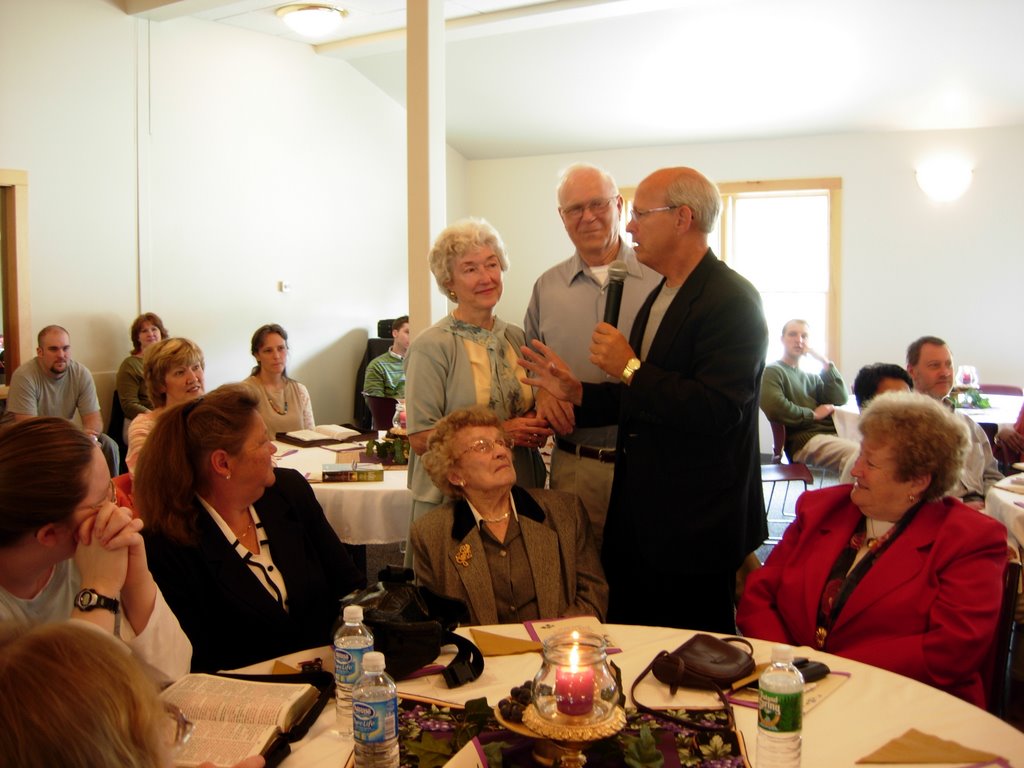
L-R: Treasures Past, Present, and Future


Treasures Past

"The LORD has done this, and it is marvelous in our eyes." Ps 118:23 NIV


Yesterday, I was invited back to Ellsworth Assembly of God to celebrate with the congregation their 25th Anniversary of the church's existance. It is hard to believe that 25 years ago, Jeanne and I drove into Ellsworth to plant a church. It has been quite a journey. It was fun to be among old friends and and make new acquaintances. Not only did we celebrate the past, we celebrated the present , and are looking to the future for this congregation. The verse above was used at our building dedication in 1986 and it still is true today. The establishing of the church was truely the work of God.

I preached a message titled "New Treasures and Old: Navigating and Transitioning Through Change." I used as my introductory text, Matthew 13:51-52:

"Have you understood all these things?" Jesus asked. "Yes," they replied. He said to them, "Therefore every teacher of the law who has been instructed about the kingdom of heaven is like the owner of a house who brings out of his storeroom new treasures as well as old."

I then transitioned to my central text found in Luke 5:1-11.

One day as Jesus was standing by the Lake of Gennesaret, with the people crowding around him and listening to the word of God, he saw at the water's edge two boats, left there by the fishermen, who were washing their nets. He got into one of the boats, the one belonging to Simon, and asked him to put out a little from shore. Then he sat down and taught the people from the boat. When he had finished speaking, he said to Simon, "Put out into deep water, and let down the nets for a catch." Simon answered, "Master, we've worked hard all night and haven't caught anything. But because you say so, I will let down the nets." When they had done so, they caught such a large number of fish that their nets began to break. So they signaled their partners in the other boat to come and help them, and they came and filled both boats so full that they began to sink. When Simon Peter saw this, he fell at Jesus' knees and said, "Go away from me, Lord; I am a sinful man!" For he and all his companions were astonished at the catch of fish they had taken, and so were James and John, the sons of Zebedee, Simon's partners. Then Jesus said to Simon, "Don't be afraid; from now on you will catch men." So they pulled their boats up on shore, left everything and followed him.

My points were this: (1) Preliminary step: Our full attention is needed; Get in the right position and right place and get in the boat with Jesus, (2) Hear God's direction, (3) God's direction may seem unreasonable, (4) His direction requires our faithfulness, (5) God's direction brings fulfillment, (6) God's direction includes others (cooperation), (7) Give God the glory, (8) Leave the past behind (Get out of the boat with Jesus).

Friday, September 29, 2006

Recommended Reading

If you are sincerely interested and desirous of being an impact player in the Kingdon of God, then this book is for you: Off-Road Disciplines: Spiritual Adventures of Missional Leaders. It is written by a good friend, Earl Creps. Earl approaches the disciplines in a different manner. He explores 12 central disciplines. Six are personal: death, truth, perspective, learning, witness, and humility. Six are organizational: assessment, harmony, reflection, opportunity, sacrifice, and legacy.

There other ways of encountering God, outside of the spiritual disciples such as prayer and Bible reading. I have personally been inspired and challenged by Richard Foster's book, "Celebration of Discipline" and Dallas Willard's book, "The Spirit of the Disciplines." These authors have radically changed my personal disciplines.

However, Earl's book leads me on a new journey of understanding and appreciation of God's unique and personal working in my life. If you are wanting to understand our post-modern culture and are intent on effectively reaching culture, this reading is for you. Dan Kimball says it well in the forward of Earl's book: "Earl writes about the most important thing he has discovered in all his exploring of the Church: the life of the missional leader and its effect on a missional organization."

No, I am not pushing the book because a friend wrote it. I am pushing it because we need to do church differently. Read the book and then share your thoughts with me. You can order it through Amazon. A free download of an excerpt from Off-Road Disciplines is available at this link. http://www.agts.edu/faculty/faculty_publications/articles/creps_offroad_disciplines.pdf

Thursday, September 28, 2006

A Flawless Word

In my devotions this morning I read:

"Every word of God is flawless; he is a shield to those who take refuge in him." (Proverbs 30:5 NIV)

First, remember "every" word of God, not some, not part, not only what we want to read or hear or listen to is flawless. There are very few people who can make a claim that their word is flawless. Secondly, God is our shield if we choose to come under His protection, rule, or care. What comforting thoughts to those who rest (trust) in Him.

Enjoy your day in Christ! There is nothing for you to fear when you believe in God's flawless word and choose to live under His presence.

Wednesday, September 27, 2006

Local Cultural Issues

Our local paper, the Portland Press Herald has only validated yesterday's thoughts on conflict and culture. You can read the article, "Bias Study Prompts Reflection, Criticism" and viewer comments for yourself by going to their web site http://pressherald.mainetoday.com/news/local/060927bias.html

Tuesday, September 26, 2006

Conflict and Culture

I remember very clearly my first conflict experience with cultural diversity as a newly arrived cadet from New Jersey to North Georgia College in Dahlonega, Georgia in the summer of 1969. Being a northerner in the deep south made me a target for jokes and ridicule. Those southerners kept reminding me to save my southern money as the south would rise again. After several days of light hearted ridicule, I finally responded by telling my fellow cadets that their southern money would not be needed as we northerners would just send General Sherman on his march through Georgia again. It was the wrong thing to say. Needless to say, I was nearly crucified for my insensitive remarks. I had stirred some deep feelings and had created conflict.

On another occasion after having just moved to Ellsworth, Maine, which is considered a part of “Down East” Maine to plant a new church, I stood in line at the local post office to open a new postal box. There were a number of individuals ahead of me in line. The postal clerk behind the counter would take a few minutes to converse with each individual. The subject of each conversation was the same. It had to do with that day’s weather. My New Jersey upbringing caused me to believe that such conversation was a needless waste of time when there was a line of individuals waiting to be assisted. I had places to go, people to see, and things to do. I fumed and sputtered under my breath as I waited my turn. When it arrived, I found myself being confronted by the exact same conversation. Here I was, a complete stranger, and now the postal clerk was engaging me in the same manner. Fortunately, I did not allow my cultural past to create conflict in my new cultural setting.


Cultural diversity and subculture exist everywhere in society. Such settings are bound to cause conflict. We are living in a world in which different cultures are becoming increasingly interlocked to one another by technological advances in travel and communication. In order to be more effective in ministry we need to have a clearer understanding of and sensitivity to the various dynamics that are at work in a conflict that crosses cultural environments. It is important to understand how our own and other cultures’ responses to conflict are formed and influenced by cultural myths, histories and values.

Cultural customs and traditions have an influence on how we deal with and resolve conflict. These all vary from culture to culture. The same holds true for individuals since they are members of and influenced by cultural subgroups that have their own personality, values and rules. It is important for pastors to understand the culture within which they are ministering. Understanding the culture of the geographical region, community and local church will not necessarily eliminate conflict but will help to resolve conflict in a creative or constructive manner
.
George Barna, founder and president of the Barna Research Group, wrote, “To remain relevant and influential, we must be current in our understanding of cultural changes and their implications. The changes that influence our lives and ministry fall within these key domains: demographics, attitudes and values, lifestyle and behaviors, and spirituality” (“The Second Coming of the Church,” Enrichment, Winter 2000). Barna goes on to write that if we understand the culture we are in, the more responsive we can be in developing and providing for the needs of the people to whom we are ministering.

Conflicts are inevitable. How we resolve conflict is important. As believers in Christ, we have been given the ministry of reconciliation.

Monday, September 25, 2006

Think in terms of a lifetime of preparation!

We need to think in terms of a lifetime of preparation. Recently, I was asked the question, “Why are you involved in graduate studies.” A few years ago, I was talking with my cousin’s son who had just graduated from a major university with a bachelor degree in history. At the time he was hoping to become a high school history teacher. During our conversation he happened to mention that the state in which he resides requires that every teacher must complete a master program within five years or face not being re-certified. This goes much further than most states that either require continuing education credits (CEC’s) or continuing education units (CEU’s) for ongoing teacher certification. It is a fact that many professions require individuals to complete a certain number CEC’s and CEU’s to remain certified or licensed in their professional careers. Such requirements, no doubt, are meant to assist these professionals to stay current in a rapidly changing world. My cousin’s son didn’t seem to mind this additional burden of continuing an educational process at all. He saw it as a profitable benefit in his personal life. Our conversation caused me to do some internal evaluation of my own personal educational pursuit and that of our ministers and lay leaders.

I consider myself a late comer to hearing and pursuing the call of God into full-time ministry. I did not have the luxury or the flexibility of enrolling in one of our many outstanding A/G Bible colleges. Instead, I pursued my ministerial preparations by correspondence through Berean School of the Bible, division of Global University. This educational process served me well as a foundation for ministry. However, over time I have had to continue to hone and improve my ministry skills. This process has taken many directions and forms, from reading books and magazines to attending various training conferences. These forms of continuing education have helped me to develop my abilities and calling. However, in 1999, at the age of 48, I enrolled in a bachelors degree program through distant education with one of our A/G Bible colleges. It has been this structured learning process of a distance education degree program that challenged and motivated me personally. Since then I have been able to enroll in AGTS. Although, it is going to take me many years to complete a degree program, I am finding this continuing education process to be refreshing in spite of the additional work load that it has created.

It is vitally important that all of us move beyond our present education level in order to become more effective ministers of the gospel. The most often used excuses for not continuing our education is age, time and money. Indeed, I have tried to use each one of them too. However, once I made the commitment to pursuing a degree program, I have discovered that each of these hurdles can be overcome. It is a matter importance, priority and faith.

I believe there are several reasons why ministers and lay leaders need to consider furthering their education. (1) If we take our calling seriously, we have a responsibility to grow in our understanding of God’s Word and our ability to minister in the church. The people we minister too will grow proportionately too our level of growth. (2) We are called to be a life-long learner (2 Timothy 2:15). The day we stop learning is the day we stop growing. (3) If we expect to remain relevant in this rapidly changing culture we must continue to refine our skills. Ministering to today’s issues is more complex than it was a generation ago. (4) Formal education (classroom or distant education settings) hold the learner accountable. Disciplines are learned and maintained. (5) Continuing an education can open new doors of ministry. There are ministries such as chaplaincy, Bible College teaching, counseling, etc., that require specific educational requirements or advanced degrees. If a door of opportunity opens, I will be able to say, “Here am I Lord, send me.”

Whatever form my continuing education may take, it will enrich my personal life and keep me as a ministry leader on the cutting edge of a complex, demanding, and ever changing culture. I hope you too will think in terms of a lifetime of preparation. I hope you will never grow tired of learning.

2 Tim 2:15 KJV
Study to shew thyself approved unto God, a workman that needeth not to be ashamed, rightly dividing the word of truth.

Friday, September 22, 2006

Treasure Both the Old and the New

In Matthew 13 we find Jesus teaching through parables or stories that the Kingdom of Heaven is like:

sowing of seeds
a mustard seed
hidden treasure
fine pearls
a fishing net

"Have you understood all these things?" Jesus asked. "Yes," they replied. He said to them, "Therefore every teacher of the law who has been instructed about the kingdom of heaven is like the owner of a house who brings out of his storeroom new treasures as well as old." (Matthew 13:51-52 NIV)

My thought today is what to do with the old and new? How do we appreciate the past and the present? How do we relate the past with what is happening today? Is the the Bible relevant today? Of course it is. The message doesn't change, but it does require new methods of presenting it. Its the treasure of bringing forth the old and the new.

Another Penn State football weekend is upon me. PSU faces #1 Ohio State. I'm sure my brother and his family will be watching and cheering for OSU since my sister-in-law is an OSU graduate. Oh well . . . Go PSU. Coach Paterno has been coaching in one school longer than any other coach. He is like old treasures. He is coaching players that are the age of grand children - new treasures. Bringing forth the best of old and new treasures creates winning seasons. Are you getting my drift spiritually? Have a great weekend

Thursday, September 21, 2006

Who are you trying to be?

Rex Miller, author of the book, The Millennium Matrix, writes, "Authenticity derives its power out of a clear sense of identity." Authenticity is knowing who you are. Authenticity is not a false sense of security or self assurance. Authenticity is real. It is genuine. It is not an imitation or a copy.

Who are you? Are you copy of someone else or are you the real thing? Are you an imitator of others? Try this. Be yourself. You were created by God with purpose.

Psalm139:13-16 NIV

"For you created my inmost being; you knit me together in my mother's womb. I praise you because I am fearfully and wonderfully made; your works are wonderful, I know that full well. My frame was not hidden from you when I was made in the secret place. When I was woven together in the depths of the earth, your eyes saw my unformed body. All the days ordained for me were written in your book before one of them came to be."

People are looking for authenticity in relationships.

Wednesday, September 20, 2006

What are you made of?

This morning I read, "If you falter in times of trouble, how small is your strength!" (Prov 24:10 NIV)

We often think of our struggles, trials, or troubles as being character builders. How often has someone attempted to console me by saying, "God is building character in your life." But that is not what the writer is saying in this verse. Could it be that the writer has discovered that troubles reveal what we have already learned? Could it be possible that our trial is an opportunity to display what we are already made of?

Alicia Chole in her book, Anonymous, discusses this very thought.

Tuesday, September 19, 2006

Embrace Life!

I found my devotional this morning humorous. Sometimes, I just can't help but laugh at some of our words used in our different versions of the Bible. For example, this morning's passage:

Mark 11:22-25

Jesus was matter-of-fact: "Embrace this God-life. Really embrace it, and nothing will be too much for you. This mountain, for instance: Just say, 'Go jump in the lake' — no shuffling or shilly-shallying — and it's as good as done. That's why I urge you to pray for absolutely everything, ranging from small to large. Include everything as you embrace this God-life, and you'll get God's everything. And when you assume the posture of prayer, remember that it's not all asking. If you have anything against someone, forgive — only then will your heavenly Father be inclined to also wipe your slate clean of sins." (from THE MESSAGE)

I like the choice of the words, "no shuffling or shilly-shallying." In other words, "It will happen!" The word of God is awesome. Read and enjoy it. Enjoy your time with God. A devotional life does not have to be dull or boring. As Jesus said, "Embrace this God-life." Enjoy life. It's not always, meant to be serious. I can't imagine Jesus without a sense of humor.

Friday, September 15, 2006

Running Behind Schedule

I'm at my favorite coffee shop, Maine Bean, here in Windham. It's unusual for me, but I am a little behind schedule this morning. The good news: God is never late. He is always on time. In fact, His timing is always perfect. Consider these words of Solomon:

There is a time for everything, and a season for every activity under heaven: a time to be born and a time to die, a time to plant and a time to uproot, a time to kill and a time to heal, a time to tear down and a time to build, a time to weep and a time to laugh, a time to mourn and a time to dance, a time to scatter stones and a time to gather them, a time to embrace and a time to refrain, a time to search and a time to give up, a time to keep and a time to throw away, a time to tear and a time to mend, a time to be silent and a time to speak, a time to love and a time to hate, a time for war and a time for peace. What does the worker gain from his toil? I have seen the burden God has laid on men. He has made everything beautiful in its time. He has also set eternity in the hearts of men; yet they cannot fathom what God has done from beginning to end. Ecclesiastes 3:1-11 NIV

On another note: GO PENN STATE!!!!! Yes, they lost to the Irish last weekend. ND out played my Nittany Lions. PSU has a very young team, about 63% of the suited players are freshmen or sophomores. They will be out to redeem themselves this week against a very good Divsion I-AA team, Youngstown State. Meanwhile ND has to play Michigan. Go Wolverines!!!! I am always a Big Ten fan. Sorry about that Charlie Wiess. You were a New Englander when you were with the Patriots, but you can't replace my favorites: Big Ten and Penn State football.

Thursday, September 14, 2006

Carpe Diem

Carpe Diem literally means "pluck the day." Or as it became known from the film, Dead Poet Society, starring Robin Williams, "seize the day." In my devotions with Jeanne this morning, we were reading the story of the blind begger, Bartimaeus, and his encounter with Jesus on the road outside of Jericho (Mark 10:46-52). When Bartimaeus heard that Jesus was passing near by, he cried out for mercy. The crowd traveling with Jesus basically told Bartimaeus to be quiet, but he continued to cry out for mercy. Jesus stopped by him, listened to his request and healed the man.

My thought on finishing the reading was, that we like Bartimaeus, must not let opportunity pass us by. Today is our day for salvation, deliverance and healing. But on further thought during my commute to the office, I realized that I cannot miss an opportunity to reach out and touch someone in need. I must "pluck" or "cease" the opportunity that calls out to me. Lord, help me to hear that voice of desperation in the midst of the many voices that may be trying to drown it out.

Wednesday, September 13, 2006

Silence - A little Used Spiritual Discipline

Both Richard Foster and Dallas Willard write about silence and solitude as under used spiritual disciplines in their books. In Ezekiel 3:15, we can read about the prophet sitting down among the people to whom he was to minister and saying nothing for 7 days. We preachers like to talk. We are encouraged to talk. People expect us to have answers for their life difficulties. We believe we have the answers. It's hard to remain silent when God has called us, anointed us, and sent us out to be shepherds and watchmen.

Prior to Ezekiel's week of silence, he has experienced an incredible vision of God's glory and majesty. He sees, he hears, he tastes God's presence. Now the Spirit lifts him away and he goes and sits among the exiles who lived at Tel Abib, near the Kebar River and sits among them. Most of us would have just started telling everyone about that holy moment. Sometimes it good to just sit rather than being spontaneous.

It would do us well to rediscover the blessings of silence. After all, we live in a loud world, filled with noise and many voices. What can we learn from Ezekiel's silence?

1. The silence of grief. Ezekiel was grieved for his people. He was taking time to enter into their grief. He was placing himself in their suffering.

2. The silence of wonder. He was taking time to reflect on what God had revealed to him. He was astonished. He was taking some time to digest and comprehend the magnitude of what had just been revealed to him.

3. The silence of sympathy. We need to take time to weep with those who weep, to mourn with those who mourn, to hurt with those who hurt. We too often speak before having taken time to experience the other person's pain or suffering.

4. The silence of anticipation. As of yet, Ezekiel had not heard from God what he was to speak. What was the message he was to share? He knew he was called to the people. But what exactly was he to say? So he waits in silence.

Tuesday, September 12, 2006

Recommended Reading

I am reading "Anonymous" by Alicia Britt Chole during part of my early morning devotions. I would recommend you getting a copy and read it, too. She is writing from the perspective of Jesus' hidden years and relating it to our hidden years. There are seasons in life when we feel we are unnoticed, whether it be retirement, educational preparations, relocation, unexplainable loss, extended illness, or for that matter any reason that might tend to hide us.

In my reading today, Chole is writing about Jesus' temptation. She referred to Jesus' experience in His wilderness as His time of preparation. His temptations suggested by the author were that of appetite, applause, and authority. Our human desire is for all three in our life. How will we be able to resist such temptations thrown at us by the devil? By spending time alone with our God in anonymity.

Chole wrote: "In the hidden years, God is our only consistent audience. Others come and go, but only He always sees. God alone realizes our full potential and comprehends the longings in our souls. When no one else is interested in (let alone impressed by) our capabilities and dreams. God is still wholeheartedly with fatherly pride shouting his love over us. Anonymous seasons afford us the opportunity to establish God as our soul's true point of reference if we resist underestimating how He treasures our hiddeness and take the time to decide whose attention and acceptance really matters in our lives."

Is God enough in my life? Is God enough in your life?

Monday, September 11, 2006

9-11 Reflections

I have experienced two major national tragedies of epic proportions in my life time. The first occurred 43 years ago on a November day in 1963. I was sitting in my 7th grade math class when the school secretary walked into my classroom, interrupting Mr. Noctor's teaching to whisper something in his hear. Upon her exiting the classroom, Mr Noctor very calmly announced, "Ladies and gentlemen, our President has been shot in Texas." School was dismissed early, and I spent the rest of the day in front of a Philco Television set, watching a grainy black and white picture, trying to piece together the stunning events of that day in absolute horror and shock. Some historians look back to this event as "the day that America lost its innocense."

The second occurred 5 years ago today. I had been busy with last minute preparations for a finance committee meeting at the district office, when one of our committee members rushed in to announce that a plane had flown into the World Trade Center. We all rushed to the A/V room and turned on the television. As we stood there watching and listening to commentators, to our horror, we actually saw the the second plane crash into the second tower. For the next hour or so we were mesmerized by the news as reports came forth of a plane slamming into the Pentagon, the collapse of the twin towers, and the eventual fate of United 93. Many in the media refer to this day's event as
"the day that changed Americans forever."

Reflecting on these two major events during my devotional time, these thoughts crossed my mind. First, Jesus said, "I tell you, my friends, do not be afraid of those who kill the body and after that can do no more. But I will show you whom you should fear: Fear him who, after the killing of the body, has power to throw you into hell. Yes, I tell you, fear him." (Luke 12:4-5 NIV)

Second, the Apostle Paul wrote:
"Put on the full armor of God so that you can take your stand against the devil's schemes. For our struggle is not against flesh and blood, but against the rulers, against the authorities, against the powers of this dark world and against the spiritual forces of evil in the heavenly realms." (Eph 6:11-12NIV)

Third, it is amazing how life changing events are captured in our minds, seemingly forever. There is another day that far exceeds those two tragic events that I have experience in my life. I remember a day that I regained my innocense and my life was forever changed; August 23, 1973. It was the day I accepted Jesus Christ as my Savior and received God's forgiveness and pardon. It has truly been a life forming event for me.

Friday, September 08, 2006

Your Life's Race


I enjoy running. Even ran a marathon many (many) years ago. I came across this encouraging reading, yesterday, by D.H. Groberg:


THE RACE
"Quit! Give up! you're beaten!"
They did shout and plead.
"There's just too much against you now.
This time, you can't succeed."
And as I start to hang my head
in front of failure's face.
My downward fall is broken by
the memory of a face.
And hope refills my weakened will
as I recall that scene.
For just the thought of that short race
rejuvenates my being.
A children's race, young boys, young men,
how I remember well.
Excitement, sure, but also fear;
it wasn't hard to tell.
They all lined up so full of hope,
each thought to win that race.
Or tie for first, or if not that,
at least take second place.
And fathers watched from off the side,
each cheering for his son.
And each boy hoped to show his dad
that he would be the one.
The whistle blew and off they went,
young hearts and hopes afire.
To win, to be the hero, there
was each young boy's desire.
And one boy in particular,
whose dad was in the crowd.
Was running near the lead and thought,
"My dad will be so proud."
But as he speeded down the field
across a shallow dip,
The little boy who thought to win,
lost his step and slipped.
Trying hard to catch himself,
his hands flew out to brace,
And mid the laughter of the crowd,
he fell flat on his face.
So down he fell and with him hope.
He couldn't win it now.
Embarrassed, sad, he only wished
to disappear somehow.
But as he fell his dad stood up
and showed his anxious face.
Which to the boy so clearly said,
"Get up and win the race!"
He quickly rose, no damage done,
behind a bit, that's all
And ran with all his mind and might
to make up for his fall.
So anxious to restore himself,
to catch up and to win,
His mind went faster than his legs,
he slipped and fell again.
He wished that he had quit before
with only one disgrace.
"I'm hopeless as a runner now;
I shouldn't try to race."
But in the laughing crowd he searched
and found his father's face;
That steady look that said again:
"Get up and win the race."
So up he jumped to try again
ten yards behind the last.
"If I'm to gain those yards," he thought,
"I've got to run real fast."
Exerting everything he had,
he regained eight or ten.
But trying so hard to catch the lead,
he slipped and fell again.
Defeat! He laid there silently,
a tear dropped from his eye.
"There's no sense running anymore.
Three strikes: I'm out, why try?"
The will to rise had disappeared;
all hope had fled away;
So far behind, so error prone,
a loser all the way.
"I've lost, so what's the use?" he thought,
"I'll live with my disgrace."
But then he thought about his dad,
who soon he'd have to face.
"Get up!" an echo sounded low.
"Get up and take your place;
You were not meant for failure here.
Get up and win the race!"
With borrowed will, "Get up," it said.
"You haven't lost at all,
for winning is no more than this;
to rise each time you fall."
So up he rose run once more.
And with a new commit,
He resolved that win or lose,
at least he wouldn't quit.
So far behind the others now,
the most he'd ever been.
Still he gave it all he had
and ran as though to win.
Three times he'd fallen stumbling;
three times he rose again.
Too far behind to hope to win,
he still ran to the end.
They cheered the winning runner
as he crossed first place.
Head high, and proud; and happy;
no falling; no disgrace.
But when the fallen youngster
crossed the line, last place,
The crowd gave him the greater cheer
for finishing the race!
And even though he came in last
with head bowed low, unproud;
You would have thought he'd won the race
to listen to the crowd.
And to his dad he sadly said,
"I didn't do so well."
"To me you won," his father said,
"You rose each time you fell."
And when things seem dark and hard
and difficult to face,
The memory of that little boy
helps me win my race.
For all of life is like that race,
with ups and downs and all.
And all you have to do to win
is rise each time you fall.
"Quit! Give up! You're beaten!"
they may shout in my face.
But another voice within me says,
"GET UP AND WIN THE RACE!"
"for though a righteous man falls seven times, he rises again"
Proverbs 24:16 NIV

Thursday, September 07, 2006

Recent Book Reading

I recently finished reading the book, Now, Discover Your Strengths, by Marcus Buckingham & Donald O. Clifton. The book basically helps you to discover your inner strengths or talents in order to be a more effective leader. The authors' assumption is that most people spend their time trying to improve their weaknesses instead of investing more time in building upon their strengths. Perhaps the most useful part of the book was the online assessment profile to discover your top five strengths. (Warning: In order to take the strengthfinder analysis, you must buy the book new, not used.)

My results and general description of that strength were:

Woo - love the challenge of meeting new people and winning them over. Derive satisfaction from breaking the ice and making a connection with another person.
Positivity - have enthusiasm that is contagious, up beat and can get along with others. Excited about what they are going to do.
Responsibility - take psycological ownership of what they say they will do. Committed to stable values such as honesty and loyalty.
Connectedness - believe there are few coincidences and that almost every event has a reason. A bridge builder for people of different cultures.
Communication - find it easy to put thoughts into words. Good conversationalists and presenters.

In the days to come, I look forward to comparing the above results with my other discoveries from Myers-Briggs Type Indicator, Taylor Johnson, DISC Profile, FIRO-B Instrument, and the Gregorc Style Delineator.

God has uniquely created each one of us. We all come in different shapes and sizes. We all have strengths and weaknesses. There are things that are important to me, that others do not care about at all. Sometimes an individual’s behavior doesn't make any sense to me, but I want to understand that person, and communicate well, because we live together in the same world. I know that I cannot expect others to want the same things that I want. We are not the same person, so we will not always see things the same way. I have my own thoughts and my own ideas, that may or may not fit into someone else’s expectation of who I should be. By learning more about my self and my own personality, and about other personality types, I can better understand myself in relationship to others. I can improve my interpersonal relationships, realign my expectations towards others, and gain a better self-knowledge that will help me help others toward spiritual emotional maturity.

Wednesday, September 06, 2006

Lessons From Joe Pa, the Coach

This past Saturday I sat down in front of my TV to watch my number one college team beat Akron. As I watched PSU dominate the game, I could not help but observe Coach Joe Paterno on the sideline. He is one amazing man at the age of 79, I believe. Where does all that energy generate from? Think about these stats:

- served as head coach at PSU for 41 seasons, 57 years as member of PSU coaching staff
- second in all-time career Division I-A victories
- winning percentage of 75% is tied for fifth best among active Division i-A coaches (minimum 10 years)
- ranks 2nd all-time in games coached (475) among major college coaches
- has directed PSU to five unbeaten seasons (1968, '69, '73, '86, '94) and two national championmships (1982, '86)
- all-time leader among coaches in bowl appearances (32) and post season triumphs (21)
- only coach to win the four traditional New Year's Day games: Rose, Sugar, Cotton, and Orange Bowls
- coached 71 first team All-Americans
- Under Paterno, PSU has produced 14 Hall of Fame Scholar-Athletes, 24 first team Academic All-Americans and 18 NCAA Postgraduate Scholarship winners.
- eighty-five percent of his players graduate from college
- coached more than 250 players who have made it to the NFL, 30 of them first round draft choices
- has coached players who have won all the major college awards: Heisman, Maxwell, Walter Camp, Lombardi, O'Brien, Outland, Butkus, Doak Walker and Biletnikoff
- he and his wife, Sue, have contributed more than $4 million to Penn State
- the 135,000 square foot Paterno Libray on campus is named after them
- they have made significant contributions to build the Pasquerilla Spiritual Life Center, dedicated in May 2003
- signed a four year contract extension that extends through the 2008 season.

As I think about Joe pa's accomplishments some thoughts arise about what makes for good coaching, not only in the sport of football, but more importantly, in life. Passion, drive, excellence, commitment, dedication, loyalty, longevity, adaptability, change, core values, character, morals, priorities, persistance, adversity, generosity. I am sure you sport fans can add to the list.

As I watched Coached Paterno pace the sidelines, I noticed that he spent a great deal of time communicating with his assistants. Yes, he spoke to players, but most often he was communicating with his assistants. I relate ministry to that of coaching. Jesus is our ultimate example of an incredible coach. Yes, Jesus was available to the multitudes, but he invested the greatest portion of ministry time with the Twelve. He invested himself in them. Pastoral and minstry burnout can be avoided as we invest ourselves in key people around us. May your seasons be many as ministers of the Gospel.


Who will win the PSU - Nortre Dame game this Saturday? I am a believer - the Nittany Lions, of course.

Tuesday, September 05, 2006

Five Steps to Becoming a Better Listener

We can improve our social life by becoming better listeners. I have been reading Proverbs during my early morning devotions. I am amazed at the number of times the writer says, "listen." I guess I should be counting them, but I haven't. Become a better listener by:

1. Committing yourself to real change. Change is a choice. I choose to learn to listen. Think about how listening better could change or improve your relationship with others.

2. Getting feedback from someone who knows you well. Ask a close friend how they think you can improve your listening skills. Speaking of friends, the Bible says, there is a friend that sticks closer to you than a brother. Have you talked to God about this?


3. Being watchful. Pay attention to your behavior. When are you most likely not to listen effectively? Pay attention to the habit that you are trying to change. Discipline one's self.

4. Using your failures as an opportunity. When you revert to your old habit of not listening, think about how you could have handled that situation better if it were to happen again in the future. I have learned this saying that was shared with me along time ago, "The only time you fail is the last time you try."

5. Keep on trying. Life is a school. No matter how well or bad one is doing, the key is to keep on trying and learning new approaches to doing things. Why keep doing the same thing over that you don't like about yourself? Try something different. This leads me back to the first step, change.

Friday, September 01, 2006

Labor Day Thoughts

Here are my thoughts regarding Labor Day:
ONE

It is a sign that summer is about to come to end and that I don't have much time left to enjoy my boating and water activities.

TWO


It's time for FOOTBALL!

GO PENN STATE!!!!!!

THREE

It's time to start getting prepared for winter.

FOUR

Labor Day is set aside to honor the hard work of the American people. I am reminded of the story in the Old Testament of Abraham who sent his servant on a mission to find Isaac a wife. As the servant sat at a well, we read:

Then he prayed, "O LORD, God of my master Abraham, give me success today, and show kindness to my master Abraham. See, I am standing beside this spring, and the daughters of the townspeople are coming out to draw water. May it be that when I say to a girl, 'Please let down your jar that I may have a drink,' and she says, 'Drink, and I'll water your camels too' — let her be the one you have chosen for your servant Isaac. By this I will know that you have shown kindness to my master." Before he had finished praying, Rebekah came out with her jar on her shoulder. She was the daughter of Bethuel son of Milcah, who was the wife of Abraham's brother Nahor. The girl was very beautiful, a virgin; no man had ever lain with her. She went down to the spring, filled her jar and came up again. The servant hurried to meet her and said, "Please give me a little water from your jar." "Drink, my lord," she said, and quickly lowered the jar to her hands and gave him a drink. After she had given him a drink, she said, "I'll draw water for your camels too, until they have finished drinking." So she quickly emptied her jar into the trough, ran back to the well to draw more water, and drew enough for all his camels. (Ge 24:12-21 NIV)

What I find interesting is Rebekah's willingness to go the extra step. She didn't have to do more than give the servant a drink of water. But she chose to water his camels too. Camels drink a lot of water. I read somewhere that camels are capable of drinking up to 35 gallons of water. Earlier in the chapter we are informed that the servant took 10 camels on the journey. Wow! Rebekah carried up to 350 gallons of water from that well. My point is not the exact amount of water. My point I want to make is that we see an individual who is desirous of not just settling for doing average or doing what is expected. She is set on excelling at what she does. She is set on doing the extraordinary! The New Testament says it this way, "And whatever you do, whether in word or deed, do it all in the name of the Lord Jesus, giving thanks to God the Father through him." (Col 3:17 NIV) Have a great Labor Day weekend!